Editor’s note: Before Israel’s ongoing attacks on Lebanese territory and sovereignty, Raseef22 worked closely with the writer on this story, which was already at risk of being completely forgotten by the news cycle. Its urgency is delayed by the massacres and bombardments that Israel is subjecting Lebanese citizens to daily. Still, the dangers presented by Tripoli’s deteriorating infrastructure continue with little to no support as the Lebanese government attempts to navigate the demands of aid, diplomacy, and rising sectarian tensions.
We hope this story serves as a reminder of the many lives we risk losing at the hands of state neglect.
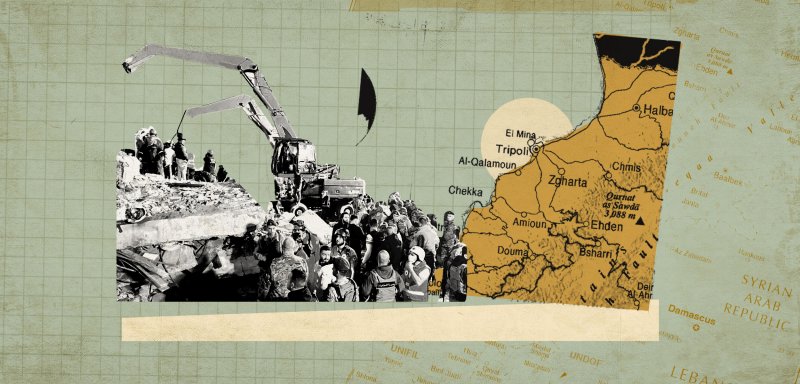
On Sunday, February 8, a thunderous noise shook Tripoli. A residential building in the Bab Al-Tabbaneh neighbourhood collapsed, trapping its residents inside.
More than a hundred other buildings in Tripoli have been classified as critical, their residents receiving evacuation orders, with up to a thousand more believed to be severely deteriorated.
Rescue operations continued into the next day as anxious locals awaited news, many of them volunteering their time and joining the efforts. On Monday morning, a woman who had been trapped inside her kitchen, where she had been preparing food at the time of the collapse, was the last survivor pulled from the rubble. She was rescued alongside seven others. Fifteen bodies were carried out lifeless.
This marks the third infrastructural collapse since the start of the year. Just two weeks earlier in Qoubbeh, a collapsed building killed a mother and daughter who were waiting on a relative to help them with their evacuation.
Angry residents immediately took to the streets in protest, with several attempting to attack the homes of politicians, while members of the city council submitted their resignations.
This marks Tripoli’s third infrastructural collapse since the start of the year. Some residents worry that owners are deliberately neglecting their buildings, hoping to pressure tenants into leaving so they can issue new contracts with higher rents.
Despite the shock that has swept through Lebanon’s northern city, few are surprised. Tripoli’s residents are well aware of the dire conditions they live in, many of whom remain in their homes despite repeated warnings about the buildings’ poor state, but they have either resigned their fate to God or have nowhere else to go.
The word echoing through the streets of Tripoli is neglect. How has the country’s second-largest city been brought to such a state?
Crumbling walls inside a forgotten city
Tripoli is the poorest city in Lebanon in terms of economic indicators. The city is home to more than 700,000 people in a relatively small area, resulting in high density and higher risks posed by the fragile state of many buildings. Aside from high unemployment and widespread social hardship, this also translates into an alarming housing situation, with the highest number of buildings in the immediate risk of collapse in the country.
“In Tabbaneh, you have some of the largest buildings in the city,” Rana, a 40-year-old social worker, told Raseef22. She recently moved out of her neighbourhood due to safety concerns. “In my old compound alone, there are up to a hundred families. It would be an absolute massacre if it collapsed.”
Rana’s house is one of many in the area marked as critical. The buildings are old, rarely inspected, and largely built without permits, many designed for just a few floors, yet built up far beyond what they could safely bear.
Basements typically flood with water and sewage every winter and are rarely pumped out, leaving the moisture to eat away at supporting columns while exposed iron foundations corrode until they crumble.
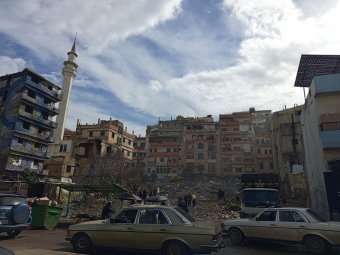
On Sunday, February 8, a residential building in the Bab Al-Tabbaneh neighbourhood collapsed, trapping its residents inside. February 9, 2026. (Photo courtesy of Layla Bartheldi).
Another resident demonstrated this vividly, chipping off a piece from a load-bearing column between his fingers: “This is supposed to hold the whole building. It’s chalk.”
The 2023 earthquake catalyzed the destruction, collapsing one building in Zahrieh and undermining the foundations of many others. Like nearby Qobbeh, Dar Al Maghar, Zahrieh, and the Old Souk, the area still bears the scars of the Civil War.
But much of the damage can also be traced to clashes between the Sunni Bab Al Tabbaneh quarters and the neighbouring Alawite Jabal Mohsen. Fuelled by tensions in Syria, these clashes have continued until 2015, leaving hundreds of casualties and severe structural damage that has not been repaired.
Who does Tripoli blame?
The roots of Tripoli’s neglect can be traced to its opposition to separating from Syria and joining the modern Lebanese republic. Tripolitan elites framed their leadership as an anti-colonial struggle and refused to participate in the state’s novel form of politics that privileged Maronite Christian political and economic supremacy under the French Mandate.
The focus on Mount Lebanon’s economic development left Tripoli with scarce resources – a disparity established a century ago that is vividly felt today, and documented in politicians’ reactions to the recent tragedy.
“In my old compound alone, there are up to a hundred families. It would be an absolute massacre if it collapsed.”
The city’s representatives, elected last May after a long absence of local leadership, have submitted their resignations to Interior Minister Ahmad Hajjar. Tripoli’s municipal chief, Abdel Hamid Karimeh, stated that the situation is beyond the municipality’s means, calling the city he holds responsibility for “disaster-stricken.”
“People now think it’s an admission of our guilt,” said council member Bassem Zawdeh, dismissing the interpretation. The resignation, he explains, was meant to pressure the government into action, not to concede responsibility. Since their resignations have not been accepted, nor are expected to be, council members must continue carrying out their duties.
Much of the public’s initial rage was directed at the municipality, but in the days since the collapse, public opinion has begun to shift.
“People were first angry mainly at the municipality, but now they are beginning to understand that its powers are limited and are blaming the central government,” said Shafik Abdulrahman, founder of Utopia, an organization dedicated to empowering local communities in and around Bab al-Tabbaneh.
By limited powers, Abdulrahman is referring to the municipality’s meagre budget and the narrow scope of its authority. According to the current council member, Bassem Zawdeh, the previous council had a budget of 60 million dollars at its disposal, which was never used. “It was held in Lebanese lira, so it lost all its value after 2019, and we are now left with nothing,” remarked Zawdeh.
In terms of authority, the municipality can issue warnings to building owners to carry out repairs, intervening directly when a structure poses a public danger – with the costs then billed to the owner as a debt.
“We also had many politicians from Tripoli in parliament, and they never did anything,” Abou Rahman continued. One name in particular resonates in the streets: residents are pointing out that Tripoli’s own Najib Mikati, who once again appeared on the Forbes list as Lebanon’s richest man.
“It’s such a disgrace. He could fix all the buildings in the city if he cared,” echoed Rana.
Many point out that the government not only fails to act but actively resists any attempts at decentralisation, both in the distribution of funds and in the fabric of everyday life.
“Do you feel like there is any state here?” asked Ahmed, owner of a small electrical shop in the Tal area. “Nobody cares about us.”
Weak regulations and the absence of crucial laws have also benefited another group now drawing much of the blame – landlords.
Under Lebanon’s old rent law, rents were pegged to the Lebanese lira, leaving them drastically below pre-crisis value. While tenants can hardly be blamed for the currency collapse that devastated their lives, this arrangement leaves many landlords with too little rental income to invest in building repairs. The situation is further complicated by ownership vacuums: many original landlords have died, and their properties have not been claimed by rightful heirs.
The roots of Tripoli’s neglect can be traced to its opposition to separating from Syria and joining the modern Lebanese republic. Tripolitan elites framed their leadership as an anti-colonial struggle and refused to participate in the state’s novel form of politics that privileged Maronite Christian supremacy.
Meanwhile, wealthier landlords have used the crisis to their advantage. Some residents worry that owners are deliberately neglecting their buildings, hoping to pressure tenants into leaving so they can issue new contracts with higher rents. Others have recently hiked prices sharply, exploiting the surge in demand as displaced people across the city scramble for safer housing.
“Some have even jumped up by 100 dollars monthly,” Abdulrahman informs about the situation in the community.
But some accuse those closer to home. Several people in Bab al-Tabbaneh admitted that many neighbours have refused to contribute to repair costs or stop dumping rubbish into the basements, accelerating their building’s decay. While some residents who could afford to contribute simply choose not to, for most, the costs are far beyond their means.
The cycle of poverty that many in Tripoli are trapped in is further fuelled by the absence of jobs, particularly for young people, alongside scarce education opportunities and basic services.
Essential services are disproportionately expensive in poorer neighbourhoods compared to wealthier parts of the city. In nearby Mina, middle-class families typically pay around $100 a month for 24-hour metered electricity. In Bab al-Tabbaneh and the Old City souks, residents pay up to double that – for just 12 hours a day. The near-absence of state electricity has allowed mafia-like structures to take hold, locking residents into dependency on costly private services.
Poverty leaves residents vulnerable to risk behaviours, including recruitment into violent activities and substance abuse. A report by MARCH – a Tripoli-based organization promoting social cohesion and conflict resolution – highlights the link between the growing prevalence of substance abuse and factors such as poverty, conflict, and educational deficits. Together, these dynamics further compound an already pervasive sense of despair, rooted in decades of empty promises.
Inspections and evictions
A week after the tragedy, council member Zawdeh is out inspecting Tripoli’s building – not as a city official, but as an architect. This work is part of a Ministry of Culture programme that began surveying the Old City two months earlier, predating the current crisis. Most residents open their doors willingly, pointing out cracks in the walls and voicing fears that have grown sharply in recent days.
“Do you feel like there is any state here?” asked Ahmed. “Nobody cares about us.”
Additional committees have since been formed to inspect volatile buildings reported through a municipal hotline, with most members serving as volunteers – a reflection of the chronic shortage of engineers. Previous surveys marked many buildings in critical condition, but those involved in current inspections consider them an outdated data set and are calling for new assessments.
So far, the municipality has issued eviction orders for over a hundred buildings and hired a hundred additional police officers to deliver them. Those who have left are granted yearly financial support for rent. Some have found new accommodation, others have taken refuge with relatives, and a few have relocated to a shelter set up at the Funduqie hotel in Mina.
But many residents refuse to leave their homes, worried that they won’t be allowed to return after reconstruction. In Qoubbeh, some residents pitched tents outside the buildings they were ordered to vacate.
“It was mainly men sleeping there – they sent women and children to family members and stayed to look after the house,” journalist Maysaa Nasri Riz explained to Raseef22. Several people slept outside during a heavy storm.
“We have been living like this for too long – I’ve known that since I was little that my house could collapse at any moment,” said Rana, explaining why many families choose to remain inside the buildings despite repeated warnings. Some, she said, hold onto the belief that their home will still be standing tomorrow, with little hope that any solution will be reached. And, naturally, she’s attached to her neighborhood, like many others.
Bab al-Tabbaneh is also home to a variety of businesses – furniture shops, car dealerships, and bakeries. With no clear plan in place, a sudden evacuation threatens the community’s economic security and livelihoods.
“Tabbaneh has so many great sides, especially during Ramadan. It’s the most beautiful place in the world,” Rana noted, underscoring how deeply people are attached to their neighbourhoods.
On the streets, others echo the sentiment, sharing sadness about displaced neighbours. “Where are they going to pray and break their fast now? It’s really difficult,” said Maysaa.
Can the government fulfill the promises it made?
As of the last week of February, the central government has suddenly taken a far more active role. It hired private engineering firm Khatib & Alami to assess building conditions and intervene where repairs or demolitions may be required, as council member Bassem Zawdeh informs Raseef22.
According to representatives of several local non-governmental organisations, the Ministry of Social Affairs (MoSA) is now positioning itself as the lead, discouraging them from any arbitrary interventions, at least until the essential mapping of needs is completed, after which some organisations may be asked to assist. Ultimately, the MoSA aims to control the distribution of rent support and other essential assistance, as people are expected to enroll under the AMAN programme, which is financed by the World Bank.
At the same time, Prime Minister Nawaf Salam visited Tripoli twice in February. He stressed that they are ready to confront years of neglect in Tripoli by launching development projects, including efforts to activate the Tripoli Special Economic Zone, revive the Rashid Karami International Fair, and restart operations at René Moawad Airport. His statement raised questions over whether the tragedy will be met with a complex and sustainable response directed at people’s needs or advancing business interests.
Tying relief funds to the World Bank inevitably triggers worries over risks of external dependence on international development schemes that maintain exploitative relationships and fuel American influence over the country’s internal affairs.
Prime Minister Salam’s second visit took place while protesters blocked the highway bridge to protest the one percent VAT tax increase. The government’s tax hike makes it harder to believe that the response to the tragedy in Tripoli will deliver a socially complex outcome.
In recent days, the mood in the streets of Tripoli has calmed down.
“We are used to forgetting quickly,” said Abdulrahman. His tone reflects the widespread exhaustion felt by Tripoli’s residents, further compounded by the rising cost of living—some sources, who have been struggling financially, admitted they broke their Ramadan fast with little more than dates and yogurt.
After decades of unevenly distributed investments and aid not reaching its intended beneficiaries, the streets of Tripoli are filled with scepticism. When people are asked whether they believe things will change this time, many respond that, in any case, it was shameful that the state took action only after lives were lost.
Others speak more cautiously.
“People in Tripoli will only believe that something is actually going to change once they see it,” concluded Rana.
Raseef22 is a not for profit entity. Our focus is on quality journalism. Every contribution to the NasRaseef membership goes directly towards journalism production. We stand independent, not accepting corporate sponsorships, sponsored content or political funding.
Support our mission to keep Raseef22 available to all readers by clicking here!
Interested in writing with us? Check our pitch process here!