Israel’s scorched-earth tactics predate the state itself and sit within a long colonial history of environmental destruction. One of the earliest references to ecological desolation as a military tactic is the Roman sack of Carthage in 145 BC, when later accounts claim the Romans salted the earth so nothing would grow there again.
As the self-styled heirs to Rome, Western European powers refined these tactics across their empires, from the deforestation of New Zealand to the slaughter of bison in North America, and the abrasive farming that led to the desertification of parts of West Africa.
Early Zionist settlers were well-versed in European methods. Encroachments on Palestinian farmers and clashes with them were a regular occurrence. This simmering violence would explode into the massacres of the 1948 Nakba, during which Zionist forces destroyed 531 villages, burning crops and vegetation as they went.
The destruction of natural resources to make life inhospitable to Palestinians has never stopped. The ravaging of Palestinian olive groves has become a daily fixture of occupation in the West Bank, while the olive tree itself has become a symbol of Palestinian resistance.
Lebanon was not spared these tactics. In 1948, many Lebanese villages were destroyed and ethnically cleansed. Since then, Israel’s environmental destruction has multiplied. Landmines were planted during the 1978 and 1982 invasions, and four million cluster bombs were vengefully thrown in the final hours of the 2006 War, rendering acres of south Lebanon hazardous to tread.
Glyphosate is the most widely used weedkiller in the world. Developed by the notorious agrochemical company Monsanto — acquired by Bayer in 2018 — it is sprayed at an industrial scale to clear fields before planting, manage weeds during cultivation, and strip vegetation along roads and rail lines.
During the 2023-2024 war, Israel systematically used white phosphorus and even employed medieval-style trebuchets to launch flammable material across the Blue Line, alongside hoses pumping gasoline onto Lebanese land to set it ablaze and bulldozers uprooting trees. Israel damaged 9,700 hectares of forests, 32,000 hectares of pastures, and 21,000 hectares of river systems, according to the World Bank. Samples from the Litani River revealed a concentration of phosphorus 20 times the average and levels of lead and cadmium above permissible limits, pointing to heavy metal contamination from Israeli munitions.
The scale of the destruction, and the restricted nature of several of the weapons and tactics deployed reveal a clear intent of ecocide. This strategy stems from the recognition that Hezbollah is not a foreign presence, but an organization rooted in the indigenous community of south Lebanon — permanently defeating it would therefore require depopulating the South by rendering it inhospitable to all life.
Glyphosate and the pesticide lobby
Israel’s turn to glyphosate echoes the United States’ tactics when it failed to defeat the Vietnamese resistance. In a desperate attempt to deprive the Viet Cong of its terrain advantage and destroy the livelihoods of its communities, the U.S. deployed 77 million liters of highly toxic herbicides over Vietnam. This earned the U.S. the honor of being responsible for coining the term “ecocide,” but it did not prevent its defeat. Half a century later, Vietnamese communities still bear the economic costs, cancers, and birth defects, as they struggle to decontaminate their land.
Glyphosate is the most widely used weedkiller in the world. Developed by the notorious agrochemical company Monsanto — acquired by Bayer in 2018 — it is sprayed at an industrial scale to clear fields before planting, manage weeds during cultivation, and strip vegetation along roads and rail lines.
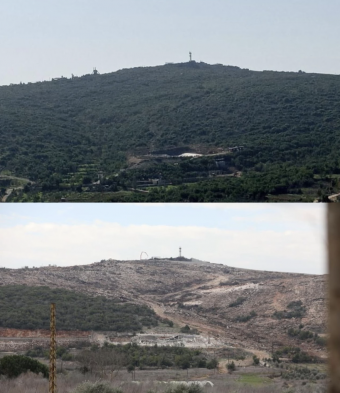
The Monk Forest before/after Israeli deforestation. (Source: Lebanese Ministry of Agriculture)
The scandal around the chemical started in 2015, when the WHO cancer agency, the International Agency for Research on Cancer, classified it as “probably carcinogenic to humans,” which contrasted with Monsanto’s claims that the pesticide was safe and non-toxic. Since then, Monsanto, then Bayer, and a consortium of pesticide companies spent at least 62 million euros lobbying European Union officials not to ban glyphosate.
Independent research found that glyphosate was not only carcinogenic but also damaged human gut health and altered the development of the nervous and reproductive systems. It also has a severe ecological footprint, damaging soil life, aquatic ecosystems, and biodiversity, with long-lasting toxic effects, including harm to pollinators. In short, the chemical is anything but safe.
When scrutiny intensified, Monsanto and later Bayer moved from persuasion to manipulation. Court filings and investigative reporting documented ghostwritten “independent” research signed by paid scientists, including a widely cited safety review later retracted in late 2025, alongside collusion with regulators and smear campaigns against critics.
Hezbollah and local residents have developed tactics that do not merely counter Israel’s violence, but also leverage their intimate knowledge of the land as its caretakers.
The pesticide lobby nevertheless kept glyphosate authorized in the EU through 2033. In the US, a landmark 2018 jury verdict, secured by Robert F. Kennedy Jr., now Secretary of Health, awarded $289 million against Monsanto on behalf of a terminally ill plaintiff, and a flood of litigation followed. Bayer has since settled nearly 100,000 glyphosate-related claims for roughly $11 billion, with 61,000 lawsuits still pending, and announced on February 17th, 2026, that it hopes to settle with another $7.25 billion. Days later, on February 19th, 2026, President Trump signed an executive order designating glyphosate “critical to national defense,” effectively treating it as war material, compelling its production if needed, and shielding producers from future liability.
Israel’s choice of glyphosate is not random. Both highly effective and toxic, it underscores Israel’s goal of scorching the land and displacing its inhabitants. Its claim that the chemical was “non-toxic” leans on the regulatory framing that has kept glyphosate authorized in the EU and protected in the U.S. Third, and most importantly, any official condemnation of Israel’s use of glyphosate would force state actors to confront not only Israel, but also the powerful pesticide lobby and the legal and regulatory consensus their own governments have helped sustain.
Green cover
Resistance to this environmental aggression, armed and civilian, sits at the opposite end of Israel’s strategy. It includes Hezbollah’s use of forest cover and its provision of agricultural and social support, and collective civilian resistance through staying on the land, exemplified by the march to the border towns on Jan. 26, 2025, replanting burned groves, tending fields under threat, and organizing mutual aid to keep communities rooted. What Israel seeks to destroy, these forms of resistance must preserve, grow, and regenerate.
In a rare public appearance, former Hezbollah Secretary-General Hassan Nasrallah participated in a tree-planting ceremony in 2010, where he planted the millionth tree of that year’s afforestation campaign, organized by Jihad al-Binaa, a Hezbollah institution that supports reconstruction and agricultural development. He declared that “Lebanon protects the tree so that it may protect Lebanon.”
Forests offer an asymmetrical advantage that allows a smaller, less-equipped force to blunt the edge of a technologically superior opponent. They provide visual shielding and camouflage from some thermal sensors, which complicates enemy surveillance and aerial reconnaissance. Dense cover can also restrict the movement of heavy vehicles, forcing invading units onto predictable routes, creating logistical bottlenecks, and exposing them to ambushes. Shells detonating in trees can also generate splinters and secondary shrapnel that injure ground troops.
Zionist settlers also recognized the strategic potential of trees in the colonization of Palestine, albeit very differently. European Zionist settlers were disappointed by a Palestinian landscape that did not live up to the pastoral biblical scenes they had expected. The Jewish National Fund, an early Zionist land-acquisition agency, financed the planting of Aleppo pine forests, a nonindigenous species later rebranded as the Jerusalem pine. These forests were planted on the ruins of Palestinian villages ethnically cleansed during the 1948 Nakba, not only to cover up the crimes of settlers, but also to erase the material possibility of Palestinian return — or, as Zionists describe it, to “make the desert bloom.”
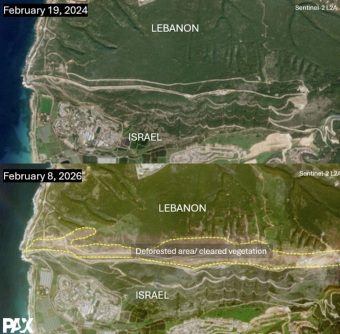
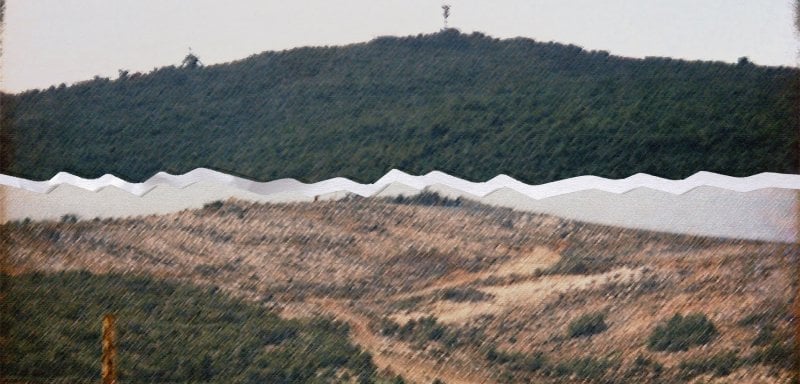
Satellite image of Lebanon’s Blue Line before/after Israeli spraying of glyphosate. (Source: PAX )
Israel and the U.S. have repeatedly accused Hezbollah of using afforestation for military ends, focusing in particular on the NGO Green Without Borders, an organization active in afforestation projects, especially but not exclusively in south Lebanon, sanctioned by the U.S. Treasury for allegedly using its outposts as cover for Hezbollah training and patrols. UNIFIL forces in south Lebanon have refuted these claims.
In a rare public appearance, former Hezbollah Secretary General Hassan Nasrallah participated in a tree-planting ceremony in 2010. He declared that “Lebanon protects the tree so that it may protect Lebanon.”
Dense forest cover has been leveraged by guerrilla movements from the Viet Cong to Cuban revolutionaries and the Mexican Zapatistas. The practice of shaping forests to meet food security, defense, and ecological needs goes back further to Indigenous peoples in the Americas, who did not practice agriculture in the European sense but “forest gardening,” shaping bushes into walls, tending trees, and even bending some as boundary markers and trail guides.
It is therefore unsurprising that Hezbollah situates itself within this longer tradition, drawing on the tactics of guerrilla warfare in the face of a more technologically advanced opponent. By 2023, Jihad al-Binaa had planted 12 million trees in Lebanon, serving both defensive and ecological needs in a country where forest cover had shrunk to 13.2 percent of total surface area in 2024.
Ecology of Resistance
Environmental warfare is a central dynamic in the conflict between Israel and the indigenous peoples of the region. In Lebanon, it is a way to impose control without formal annexation, by burning, poisoning, and exhausting the land until civilian life becomes harder to sustain.
Lebanon’s ecology is a strategic military asset and the cornerstone of civilian resistance. Maintaining forest cover, productive agriculture and water systems strengthens a natural long-term barrier against Israeli incursions and entrenches people in the land.
After three years of continuous warfare at varying intensities, south Lebanon’s communities are exhausted as they go through their second wave of mass displacement. The loss of housing and livelihoods is exacerbated by state neglect, a worsening economy, and a clear Israeli policy to prevent reconstruction and the rehabilitation of the living space in south Lebanon.
As hostilities on the southern border intensify once again, Israel appears increasingly intent on establishing an arid buffer zone deeper inside Lebanese territory. This may well be the first of many instances in which Israel scorches the land and people of south Lebanon with toxic glyphosate.
Raseef22 is a not for profit entity. Our focus is on quality journalism. Every contribution to the NasRaseef membership goes directly towards journalism production. We stand independent, not accepting corporate sponsorships, sponsored content or political funding.
Support our mission to keep Raseef22 available to all readers by clicking here!
Interested in writing with us? Check our pitch process here!