[Editor’s note: Some of our sources have requested anonymity for security purposes. Names with asterisks have been changed.]
Morocco is a country built on contradictions. It boasts the fastest train in Africa, while countless villages remain without paved roads or reliable electricity. It chairs the Human Rights Council, even as local dissent is crushed and opposition voices are defamed. It spends millions on stadiums and concerts, yet its hospitals are underfunded and schools neglected. It is a kingdom rooted in faith, yet drowning in corruption and inequality.
Before the GenZ 212 protests made news headlines, Morocco was already experiencing unprecedented social tension. This tension was exacerbated by the country’s strict grip on freedom of expression, which has tightened ever since Hirak Rif in 2017, a grassroots movement sparked by the killing of a fishmonger. Hirak protesters demanded better educational and health facilities in the region, as well as accountability for corrupt officials; its leaders, including Nasser Zefzafi, received harsh 20-year prison sentences. Activists, journalists, and bloggers were imprisoned for online posts expressing opposition to the Kingdom or criticizing political actors. This repression also led to the unprecedented rise of exiled voices speaking freely from abroad.
This year, on September 27, a youth-led protest emerged in major cities, including Tangier, Rabat, Marrakech, and Casablanca. Born out of frustration and a longing to change the kingdom’s course and the bleak future it seemed destined for, GenZ 212—considered one of the largest protests in the Middle East and North Africa since 2011—broke through these contradictions and demanded straightforward answers.
Using an eponymously named Discord server, a digital network of Moroccan youth who dared to imagine a better country for themselves took on the Makhzen face-to-face.
Something rotten in the Kingdom of Morocco
Morocco’s current coalition government, headed by billionaire businessman Aziz Akhannouch, has not only broken its promises to citizens but has also proven to be one of the country’s most corrupt governments.
In its attempt to replace the Islamist Justice and Development Party (PJD), the Makhzen—the palace and its official circles—allowed oligarchs and businessmen to enter government and parliament, introducing an unprecedented level of conflicts of interest and corruption.
Approximately 14 percent of current elected parliamentary deputies (around 55 out of 395) have corruption cases or legal proceedings against them, according to an investigative report by Civil Rights Defenders. The majority of these cases involve members of the Authenticity and Modernity Party (PAM) and the National Rally of Independents (RNI), both of which lead the coalition government.
In its second year, two prominent PAM members were implicated in the infamous “Escobar of the Sahara” drug- and money-laundering scandal. Akhannouch, an RNI leader, defended his company’s $670 million desalination deal in the Casa-Settat region, thereby violating rules against being both a regulator and a beneficiary.
The current coalition has mismanaged key sectors such as health and education by pushing further privatization. In 2022, public spending on healthcare amounted to roughly two percent of GDP; the World Health Organization (WHO) recommends at least five percent. Morocco has fewer than eight doctors per 10,000 people, far below the WHO-recommended benchmark of 20 to 23.
Walid, Field CoordinatorHow could I not take to the streets? |
As for education quality, Morocco’s performance in the 2022 Programme for International Student Assessment ranked among the lowest globally. Students scored well below the OECD average in reading, mathematics, and science, particularly in rural areas. Yet ruling elites remain nonchalant, sending their children to study abroad and relying on private clinics when ill, while some even profit through investments in private education and health facilities.
By 2023, teachers and medical students had taken to the streets as government care and attention toward their sectors continued to deteriorate.
Moroccan youth are suffocated by rising unemployment and extortionate living costs, with the minimum wage (SMIG) set at around $300. Alarmingly, the Moroccan High Commission for Planning reported in 2025 that unemployment is particularly high among young people: 35.8 percent for those aged 15 to 24 and 21.9 percent for those aged 25 to 34. Even more alarming, a 2025 report by the Economic, Social, and Environmental Council revealed that a quarter of Moroccans aged 15 to 24 are neither in education, employment, nor training—leaving them simply waiting for an opportunity to take to the streets.
As oligarchs in government expand their interests and line their pockets, Moroccan society erodes. Meanwhile, stakeholders remain laser-focused on preparations for the 2026 Africa Cup of Nations and the 2030 World Cup. Extravagant spending on host cities, while rural areas remain marginalized and forgotten, has laid bare stark wealth disparities. Many have protested the government’s actions, while others have fled by sea to Europe in search of better prospects—a contrast brought into sharp focus after the Al Haouz earthquake, which left citizens living in tents throughout winter, two years after the disaster.
This disparity between the center and the margins was exposed by last June’s Aït Bouguemez rural march, which Akhannouch claimed was politically motivated, even as protesters demanded access to clean drinking water and basic telecommunications. All the while, the state boasted about Rabat’s largest ice hockey rink in Africa. This divide was even acknowledged in the most recent Throne Day speech, when the King stated that Morocco is “moving at two speeds.”
Tensions reached a breaking point in mid-September, when eight Moroccan women died due to failed cesarean procedures at King Hassan II Hospital in Agadir—a city whose council Akhannouch presides over. Just a week earlier, Akhannouch had given state media an exclusive interview praising his government’s “positive results.”
As authorities focused on house demolitions to make way for the World Cup, young people were mobilizing online. “We don’t want the World Cup,” they chanted in the streets, refusing to die at sea. “Our health comes first.”
Brave new youth
Following news of the women’s deaths, Moroccan Youth Voice (MYV) emerged as an online campaign calling for protests on September 27 and 28.
At the same time, users across the country joined the GenZ 212 Discord server. There, they discussed how to change their country’s bleak reality, voiced their demands, and expressed their anger—while maintaining anonymity to avoid a fate similar to that of Hirak Rif activists.
Unlike earlier movements such as February 20, GenZ 212 is leaderless and does not require a physical space to convene. Discord offered an arena that could not easily be surveilled or shut down by the Makhzen. With 43 percent of Moroccans aged 18 to 29 spending three to four hours daily on social media, where else could mobilization occur but in the one space where state control is limited?
The platform proved an antidote to repression. Its tools enabled democratic practices—polls, scheduled discussions, anonymous suggestions, and collective voting. Unlike Morocco’s static political class, server administrators rotate, chosen for contribution rather than personal gain.
The digital arena also allowed equal participation across regions. Members from marginalized provinces joined without discrimination between center and periphery, creating a space where grievances could be voiced freely and protest meeting points coordinated city by city.
Jihad, Field Coordinator
I hope to see Morocco as we dream of it: a country governed by democracy, where citizens are equal before the law; where the law delivers justice; where wealth is distributed fairly; where poverty and illiteracy are eradicated; and where we can live free from the constant feeling of insecurity. We are defending the Moroccan people’s right to freedom, dignity, social justice, and equality. For the future belongs to us here, and we are, inevitably, victorious. |
Notable figures such as Omar Radi, a formerly detained investigative journalist; Sarah Soujar, a lawyer and activist; and Reda Benchemsi, journalist and founder of TelQuel, joined discussions to share their experiences. Meanwhile, state-funded Moroccan media unified their discourse to glorify the regime and highlight alleged achievements, sidelining both fringe and mainstream concerns.
When GenZ 212 members emerged in city squares on Saturday evening, Moroccan society was shaken. The myth of apathetic, politically disengaged youth dissolved instantly. Police authorities, unprepared for a movement without hierarchy or leadership, appeared rattled.
Unlike their parents, who still recall the terror of Hassan II’s Years of Lead, these protesters refused to accept oppression and hogra as their written fate. They rejected the notion that they were born to suffer.
In their manifesto, which cited constitutional articles, GenZ 212 demanded “the full and serious implementation of what is guaranteed and promised,” calling for accountability.
“If we are prosecuted after our peaceful principles are violated,” read a post on the GenZ 212 Instagram page, “then we have no regrets. All this hardship is for the sake of the homeland.”
Spring of dreams and winter of defeat
When MYV called for nationwide protests, I, like many Moroccans, assumed it was an online prank. Though I had joined the Discord server days earlier, I doubted the call would materialize. Few outlets reported it, and life seemed normal—until people began to show up.
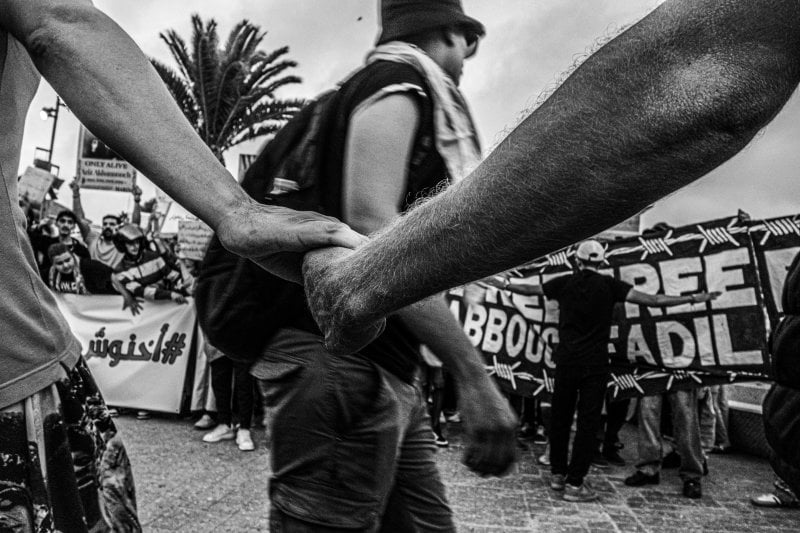
The first two days were peaceful, aside from disproportionate police presence. Rights to assembly and expression were violently suppressed on camera, prompting international condemnation. Videos of police dragging teenagers into vans and forcing them to surrender their phones went viral. Although the government remained silent, it was clear that orders had been issued to ban assemblies, yet repression failed to stem the protests.
While both palace and government stayed silent, state media did not. Channels overseen by Faïçal Laraïchi, head of the Société Nationale de Radiodiffusion et de Télévision (SNRT), publicly delegitimized the movement, broadcasting a communiqué from an “unidentified” senior intelligence official claiming protests were driven by “unknown agents” with “unknown agendas,” while praising security forces’ conduct.
On the third day, rural towns and smaller cities joined spontaneously. In Oujda, police vehicles chased and ran over protesters, causing permanent injuries to at least two people—one of whom lost both legs. In Larache, Salé, and Nador, damage was largely material. In Laqlia, near Agadir, army bullets fired near a military base killed three protesters, including a film student documenting events.
Yanis*, Field MobilizerCall out authoritarianism whenever you encounter it; don’t take the easy way out. Think of the next generation before you think of your own, and don’t underestimate the changes that can happen in ten years. |
Makhzen forces continued mass detentions under the pretext of “restoring order,” while courts issued swift and harsh sentences, some up to 10 or 12 years. A witch hunt ensued, targeting even those loosely connected to the movement. Two Moroccans were sentenced simply for printing “Free Palestine” and “Health and Education First”; the print shop associate received one month in prison.
Defamation campaigns sought to fracture public support. After a Discord discussion with journalist Aboubakr Jamaï on Amazigh entities and state narratives, fake GenZ 212 accounts appeared, accusing the movement of anti-Amazigh sentiment. Additional fake profiles mocked and ridiculed protesters. A report by Arabi Facts Hub revealed coordinated state-backed online campaigns, with activity traced to Morocco, Saudi Arabia, and France.
As violence drew global attention, the UN urged Moroccan authorities to respect protesters’ dignity and investigate fatalities. Amnesty International and Human Rights Watch condemned excessive force. On September 30, coalition parties expressed willingness to open dialogue, but GenZ 212 members rejected talks without accountability.
Like Hirak Rif before them, GenZ 212 addressed their demands directly to the King. In a letter issued on October 2, they called for government accountability and the resignation of Akhannouch, in particular.
“We are the youth of Morocco, bearers of a national mission,” the letter read, “suffering from harsh living conditions and the gap between constitutional rights and daily reality. It is our duty to raise our voices.”
The movement paused protests ahead of the King’s October 10 address. In that speech, he renewed confidence in Parliament, effectively ignoring protesters’ demands. Arrests continued. By December 23, over 37 people in Marrakech alone had received collective sentences totaling 92 years. In Agadir, Nador, and Salé, sentences ranged from 16 to 20 years. The Moroccan Human Rights Association reported 2,068 detainees by October 25, including 330 minors questioned without guardians, violating international standards of children’s rights.
Another dream deferred?
The monarchy, sanctified by religion and protected by the constitution, remains one of Morocco’s three red lines, alongside religion and territorial unity. It is unsurprising that this fractured GenZ 212, as criticism of the monarchy is punishable by law, and many still view it as a guarantor of stability.
Following the King’s speech, divisions emerged on Discord. Some opposed suspending the protests; administrators emphasized the need for reverence towards the monarchy. Others, including Reda Benchemsi and Aboubakr Jamaï, highlighted the futility of condemning business-political entanglement without addressing the royal family’s economic dominance.
Rami*, Field Organizer
I hope to see Morocco move forward: classrooms with 20 students, not 40; teachers who are equipped with the materials they need, and who are carefully selected for the job; truly free hospitals, not ones where you have to pay under the table for access; and public institutions that serve the Moroccan citizen. We want Morocco to develop, and we oppose anything that stands in the way of that. We, as field organizers, endure a lot—from police scrutiny to excessive surveillance. They’re looking for a pretext to get their hands on you. Some people don’t quite understand that if you utter the wrong word, it could be your last. To the rest of the Arab world, and to forsaken generations everywhere: make the first move and speak up without compromise. If you don’t do so now, future generations will suffer too. The voice you believe won’t bring about any change is, in fact, capable of wonders. |
King Mohammed VI’s reign began with promises of reckoning through the Equity and Reconciliation Commission and post-Arab Spring reforms pledging expanded freedoms and accountability. Yet today, harsh sentences against youth and prosecutions over social media posts betray those commitments.
In Morocco, hope has always been contested. GenZ 212 did not live through the Years of Lead, but they have discovered that the old regime persists beneath modern façades.
The movement eroded the fear entrenched in Moroccan society since Hirak Rif. Yet aside from forcing increased spending on health and education, its momentum ultimately succumbed to repression and a lack of broader societal support. The message from the Makhzen is clear: it will tolerate citizens drowning at sea before allowing the structures that send them there to be dismantled.
Even as football and festivals distract, reality remains: without dignity, justice, and freedom, new generations will resist. Morocco may one day find itself without the very people it needs to secure its future.
Liberty, it seems, remains a thoughtcrime in the kingdom—as evidenced during one protest in Marrakech’s Jemma El-Fnaa square, when a police officer ordered, “Bring me the one who shouts ‘freedom.’”
Raseef22 is a not for profit entity. Our focus is on quality journalism. Every contribution to the NasRaseef membership goes directly towards journalism production. We stand independent, not accepting corporate sponsorships, sponsored content or political funding.
Support our mission to keep Raseef22 available to all readers by clicking here!
Interested in writing with us? Check our pitch process here!