Most schoolchildren dread the end of summer vacation. The early mornings and long hours studying in the afternoon don’t sound enjoyable to kids who spent their summers wasting their days without worry. But Mahdi Hamdan, an 11-year-old from the Lebanese border village of Mais al-Jabal, is excited to return to the classroom. Like many other children from the South, he adapted to virtual schooling while his family rebuilt their lives from scratch.
In late 2023, when border skirmishes began between Lebanon and Israel, the Hamdan family fled their town to settle in Nabatieh, a city approximately 50 kilometers from the Israeli border. During the prolonged war—which escalated last fall after Israel detonated thousands of pagers across the country—Israeli strikes killed more than 4,100 people. The Israeli military destroyed swathes of civilian infrastructure and farmland in southern Lebanon, including several schools in the country’s border villages. During the war, the Hamdan family lost their home and their bedding and linen shop, their main source of income.
To encourage residents’ return, the municipality needed to find the space to rebuild two of the village’s destroyed elementary and secondary schools.
Prompted by the municipality’s announcement to reopen the local school and cover tuition fees for all students, the Hamdan family decided it was time to return to their village in August. They rented a small home where Mahdi’s parents, grandparents, and siblings could live together again.
To encourage residents’ return, the municipality needed to find the space to rebuild two of the village’s destroyed elementary and secondary schools. After weeks of searching, the ministry decided to build what they described as “temporary” complexes made from prefabricated classrooms, lightweight steel structures with insulated panels increasingly used in southern Lebanon as temporary homes in the absence of reconstruction.
This initiative is the first of its kind in the country. Some of Mais al-Jabal’s residents are concerned about the quality of these prefabricated rooms and their ability to withstand harsh weather and Israel’s ongoing security threats in southern Lebanon. But none of this matters to Mahdi. He’s just happy to be back in his village among his people.
“It feels good to be back in school after being deprived of it for so long,” he said.
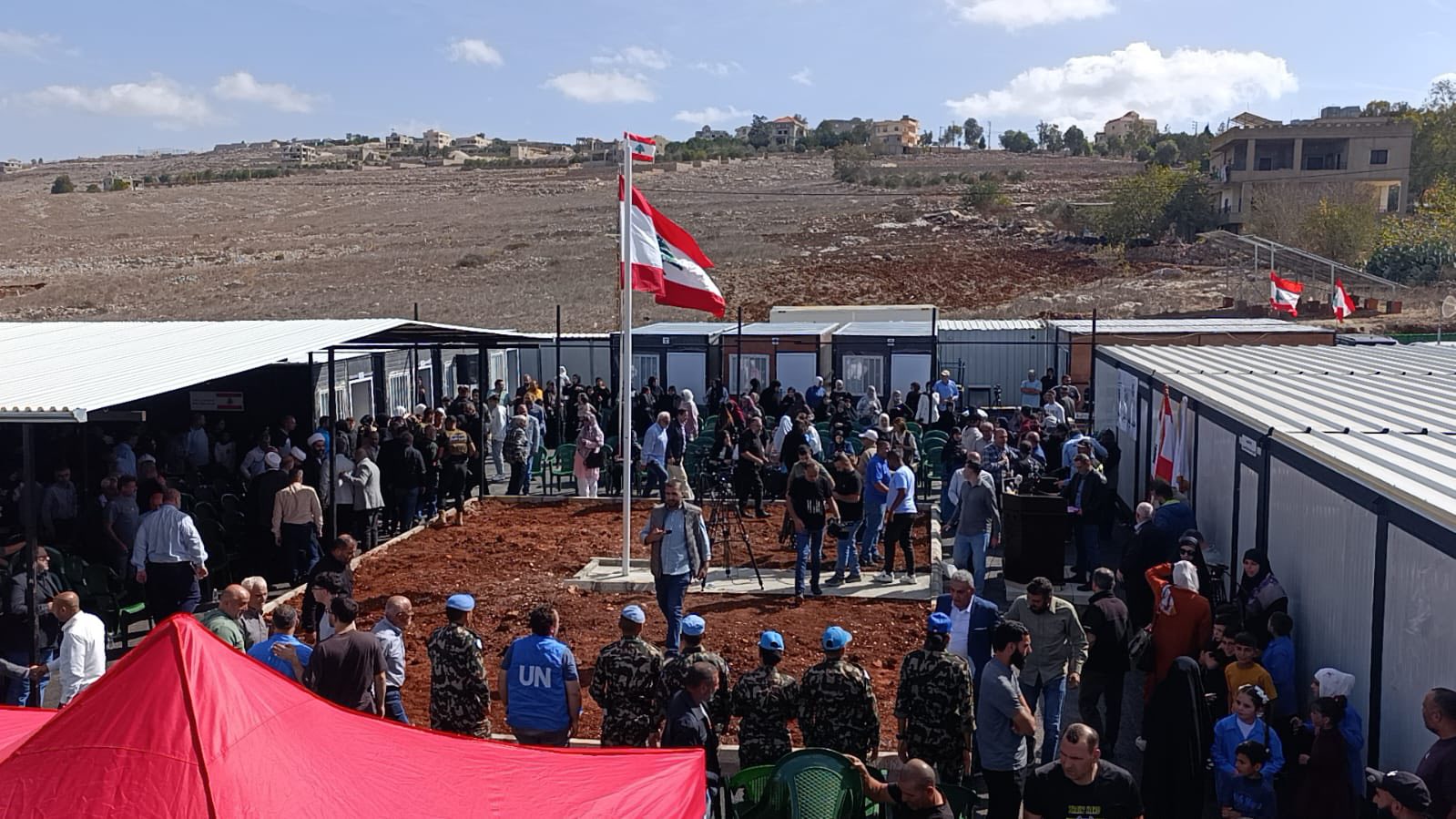 Opening day. Photo courtesy of the Mais al-Jabal municipality.
Opening day of Mais al-Jabal's new school complex on October 29, 2025. Photo courtesy of the Mais al-Jabal municipality.
A solo effort
The idea for the complex took shape in May, shortly after Lebanon’s municipal elections. These elections were designed to appoint new local councils tasked with addressing each community’s needs. For municipalities in southern Lebanon, the weight of their responsibilities was far heavier. With the national government absent from reconstruction efforts and measly funds at their disposal, local authorities had to think on their feet.
“The education system was at the top of our priorities,” said Haj Faraj Choucair, head of the education committee in Mais al-Jabal. “We needed an alternative for all of the destroyed schools.”
After several consultations and reports, the municipality decided to merge the village’s three schools—elementary, secondary, and vocational—into a single shared complex. The site, a six-dunum plot of land near the village of Shaqra, was far enough from the border to avoid any confrontation with the Israeli military. The use of prefabricated rooms was the most practical choice, given that they were already being used elsewhere as makeshift hospitals and stores, according to Choucair.
After several consultations and reports, the municipality decided to merge the village’s three schools into a single shared complex. The Al-Saedi tribe in Iraq funded the construction of 34 prefabricated classrooms.
“We rebuilt the public schools so that people could stay in the village,” Chouqair said. “Education means presence, and presence is resilience.”
The initiative has already encouraged more than 700 families and counting to return to Mais al-Jabal, according to municipal records.
In the absence of state support, the municipality relied on its own networks and partnerships to bring the complex to life. One of the initiative’s financial contributors, the Al-Saedi tribe in Iraq, funded the construction of 34 prefabricated classrooms. The connection, albeit unexpected, was forged by the Jabal Amel Union of Municipalities. Kassem Hamdan credited a union member who was in contact with the tribe and had passed along the idea for their consideration.
“We sent them the studies about the complex. The tribe agreed and offered to cover the full cost,” Hamdan told Rasseef22.
The Union continues to assist with the complex’s maintenance and funding, while the Council for South Lebanon handles groundwork, fencing, paving, and sanitary installations, including water tanks and solar power. Meanwhile, the school’s headmasters are reaching out to contacts in neighboring villages to secure supplies such as desks, chairs, and learning materials.
“We even pulled some chairs out of the rubble,” Choucair said. “We wanted everything ready by the time the schools reopened.”
‘Do whatever you want, but we can’t give you a dime.’
The complex was officially inaugurated on October 20th. A ceremony was held by the municipality and attended by representatives from UNIFIL, the Lebanese government and army, the Ministry of Education, and school directors from the South.
Habib Kabalan, the head of Mais al-Jabal’s municipality, told Raseef22 that in the absence of the state, municipalities became the only lifeline for residents living in the border villages.
“People come to us for everything: electricity, water, roads, all kinds of infrastructure work,” he said. Kabalan has taken it upon himself to ensure that all tuition fees and school supplies are covered, relying on money raised from expatriates, personal donations, and his own contributions.
“We even pulled some chairs out of the rubble,” said Haj Faraj Choucair, head of the education committee in Mais al-Jabal. “We wanted everything ready by the time the schools reopened.”
“Education is the pillar of everything,” he said. “It would be unthinkable for Mais al-Jabal to exist without a functioning school. We consider this a historic achievement made possible by many good people, and we are grateful to them.”
The Ministry of Education, on the other hand, was absent from these efforts. Its only involvement in the initiative was granting permission for the project and allowing more flexibility with the school’s opening date, which was delayed from the usual start dates in early September and October.
“They told us, ‘Do whatever you want, but we can’t give you a dime,’” said Hamdan.
In a written statement to Raseef22, the advisor to the Minister of Education confirmed that the prefabricated classrooms were donated by Iraqi tribes and that the Ministry of Education “was not involved in the planning or negotiation of this project.”
The statement clarified that the ministry’s role was limited to facilitating administrative procedures for schools in the “frontline Southern areas,” encouraging principals to manage their institutions according to local needs. The Ministry also noted that there are no available budgets for equipment or tenders, emphasizing that “this shortage affects schools across Lebanon, not only those in the South."
Israel’s ongoing mission to instill fear
A similar, smaller-scale project for a temporary schooling complex was launched in the nearby village of Houla. These efforts, trickling in one after the other, indicate that South Lebanon’s residents are eager to return to their lives in their villages.But Israeli forces continue to strike vehicles and motorcycles almost daily. Occasional infiltrations also persist. In July, Israeli troops entered Mais al-Jabal and blew up a textile factory. Just weeks ago, Israeli forces, backed by drones and armored vehicles, crossed into the Lebanese border village of Blida and shot municipal employee Ibrahim Salameh while he was asleep inside the municipal building.
“As teachers, it’s our duty not to abandon the children,” said Mariam, a teacher in Mais al-Jabal. “The state has already abandoned them. We have to be there for them.”
“We live next to an enemy that knows no mercy, but we trust that those responsible for Lebanon’s safety—President Aoun and Army Commander Rodolphe Haykal—will deal with these threats so that we can continue living on our land,” said Kabalan.
But not everyone copes with fear in the same way. For Mariam, a teacher at the complex and a mother of two who requested anonymity for security concerns, the decision to return to Mais al-Jabal was far from easy.
“I worry a lot because the security situation is still dangerous,” Mariam admitted to Raseef22. “The border area remains unsafe. Israel is unpredictable, and the destruction around us can be overwhelming.”
During the war, Mariam lived near Nabatieh, but eventually decided to move closer to her workplace in Mais al-Jabal. “As teachers, it’s our duty not to abandon the children,” she said. “The state has already abandoned them. We have to be there for them.”
At first, she wondered whether the small units could comfortably accommodate the 300 students enrolled this year and whether the quality of education could match previous years under such foreign and uncertain conditions. But after a few weeks, Mariam said she was pleasantly surprised. The rooms fit the students comfortably, and a sense of normalcy has returned, the familiar rhythm of the new semester that both teachers and children had missed.
“It’s good to be back teaching inside classrooms instead of meeting online,” she said. “We’ve gotten used to all sorts of challenges, and this is just another one we’ll overcome.”
Although the project was meant to be temporary, Kassem Hamdan said it could remain in place for up to four or five years if the government delays reconstruction. The schools still lack basic items like printers, chairs, and tables, but the curriculum, class hours, and sessions have resumed regular programming.
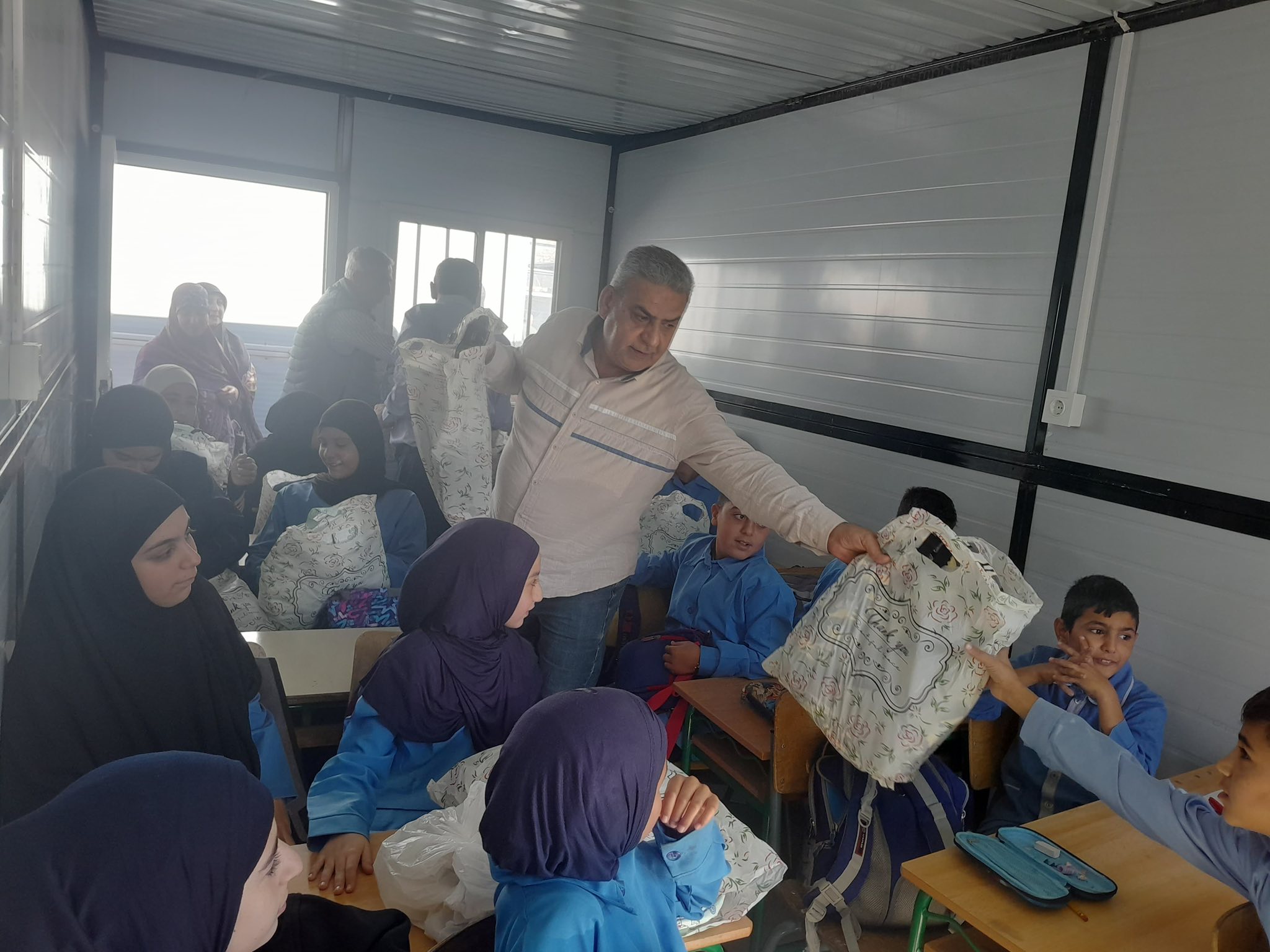 Passing out supplies to the children. Photo courtesy of the Mais al-Jabal municipality.
Passing out supplies to the children inside prefabricated classrooms. Photo courtesy of the Mais al-Jabal municipality.
“We’ll have to find the solutions as we go,” Mariam said, noting that winter could bring new challenges like heavy rain and cold weather, which might affect both the complex and the teachers, many of whom commute long distances through harsh conditions to reach the village.
“If we’re not there for each other, who will be?” she added.
Across southern Lebanon, mutual aid bolsters the region’s self-sufficiency in the face of an absent state. With little assistance from international and non-profit organizations, residents have learned to fix their own roads, rebuild their homes, and reopen their businesses. Life may not be back to what it was, but Mais al-Jabal’s school complex reflects an unspoken rule understood across the South: waiting for help is not an option.
As for Mahdi, the near-constant hum of Israeli drones and the sound of distant explosions no longer faze him.
“Meh, we’ve gotten used to it,” he said.
Raseef22 is a not for profit entity. Our focus is on quality journalism. Every contribution to the NasRaseef membership goes directly towards journalism production. We stand independent, not accepting corporate sponsorships, sponsored content or political funding.
Support our mission to keep Raseef22 available to all readers by clicking here!
Interested in writing with us? Check our pitch process here!