 إقرأ باللغة العربية:
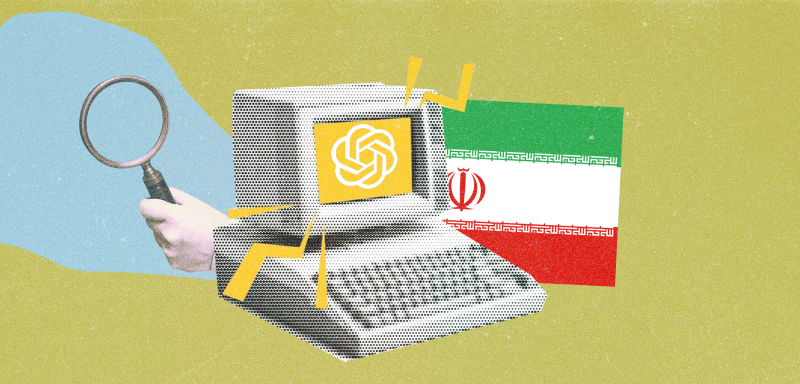
In Iran, where the state regulates internet access and imposes ever-increasing restrictions on digital content, girls and young women have found in artificial intelligence a new outlet and an alternative space for resistance.
Since the outbreak of Woman, Life, Freedom following the death of young Mahsa Amini in 2022, the landscape of confrontation between the state and society has changed. Social media platforms alone are no longer sufficient, as state surveillance has become stricter and censorship measures more complex.
In this climate, AI entered the scene as a new player, enabling faster content production, more convincing images, and messages that bypass linguistic censorship. It has thus become a kind of digital weapon in the hands of young women seeking to challenge the restrictions imposed on them.
Young women have turned to AI to produce symbolic images: women without compulsory hijab or digital artworks blending Iranian traditions with modern freedoms, carrying a distinctly feminist character as they sought to break the state’s monopoly over their identity.
Who is leading the battle?
Gen Z have found in AI tools a new outlet for their demands. What began as personal experiments in machine translation or producing artistic images quickly transformed into a space for digital resistance, and an exceptional space where technology and politics intersect.
“When I design a virtual image without a hijab, I feel as though I’m living a moment of freedom,” a 20-year-old university engineering student from Mashhad, who asked to remain anonymous, recounted to Raseef22. Meanwhile, Zahra, 25, a law student living in Tehran, explains that the experience was not only confined to the virtual arena but also gave her greater confidence in confronting her family. AI allowed her to express what she could not voice in real life.
What is particularly striking is that Iranian girls are employing AI in ways that differ from their male peers. While some young men tend to use technological tools for data analysis or organizing broad political campaigns, young women focus more on expressing issues tied to gender identity and women’s issues.
There is no doubt that feminist motivation was the strongest spark after the death of Mahsa Amini in 2022. Images of the protests and the slogan Woman, Life, Freedom became directly linked to feminist demands, foremost among them the rejection of compulsory hijab and the call for equal rights in education, work, and public space.
Within this context, young women turned to AI to produce symbolic images: women without hijab, digital artworks blending Iranian traditions with modern freedoms, or translated texts that help their stories reach the world. These uses carried a distinctly feminist character, as they sought to redefine the image of Iranian women and break the state’s monopoly over their identity.
From personal expression to political confrontation
Protests in the Islamic Republic have expanded since 2022, and so too did AI take its foothold.
Fatima, 23, from Kermanshah and a Persian literature student, sees modern applications as instruments of resistance. A year ago, she was afraid to post a political comment on her page. But the climate is different today.
“I post virtual images that reflect what I feel without fear,” said Fatima. “Satirical political memes, edited videos, and digital slogans designed with intelligent algorithms have become powerful tools of mobilization. It’s no longer just personal expression – it has become a collective means of producing an alternative narrative that contradicts what the state promotes.”
These tools allow for rapid dissemination with convincing quality, according to her. Messages created in small rooms in Tehran or Isfahan are now capable of reaching an international audience, placing the Iranian government under increased pressure.
Many young, Iranian women shared that they had initially turned to AI as a tool for self-expression. Some use text-generation programs to translate their diaries from Persian into other languages in an effort to share their stories with audiences abroad. Image and video tools allowed them to imagine and portray a new world: women without compulsory hijab, freer streets, protest symbols that are difficult to disseminate through traditional means, and algorithm-generated pictures and videos embodying the Iran that they dream of. This step became a form of cultural and political defiance at once. What makes the content even more sensitive for the state is that it does not merely challenge political authority but also shakes the cultural and social foundations on which the government builds its legitimacy.
A look into the toolbox
At the forefront of the girls’ AI toolkit is ChatGPT, used not only to generate texts and articles in English and Persian but also to reframe political slogans in an emotional language that facilitates their circulation on global platforms.
MidJourney and Stable Diffusion serve as exceptional visual tools. Meanwhile, Deepfake has been controversial, employed to mimic the faces of officials or to produce satirical videos that mock official discourse. Machine translation also plays a crucial role, allowing local experiences to translate into a global discourse aimed at international media and human rights organizations.
The result has been a frenzied race between girls trying to evade surveillance with generative algorithms, and a state pursuing them with counter-algorithms. This delicate balance reflects the nature of Iran’s struggle today, and how the digital sphere has transformed into a dual battlefield – one side innovates to liberate, while the other innovates to repress.
These tools have shifted from being mere technical platforms to arenas of digital confrontation. Through AI-generated images, we are seeing new protest symbols that echo Tehran’s murals but are reimagined with messages of liberation. Some young women are producing satirical Deepfake videos showing Iranian officials chanting feminist slogans to undermine their authority in the eyes of the public. Others have used AI to generate short clips blending traditional anthems with modern beats, widely shared on TikTok and Instagram. Even articles are now composed with the help of ChatGPT or similar tools, combining political analysis with emotionally resonant language – boosting their global reach.
Can technology act as an extension of feminist struggle?
From hijab to education, from freedom to politics, AI tools now intersect with women’s issues to open new spaces for empowerment – beyond the state's institutionalization and its narrow confines.
The long-standing compulsory hijab is the central symbol of conflict between the state and women in Iran. But with AI entering the scene, young women have been given a space to imagine the Iran they desire. These images are not just digital art, but encrypted political messages reflecting an entire generation’s dream of breaking the authoritarian grip of the state.
Despite the strict limitations on women’s participation in Iranian politics, Iranian journalist and human rights activist Sahar Beit Mashal believes that AI has opened up a parallel channel. Some young women use it to write opinion pieces or draft human rights petitions in foreign languages, which are then sent to international organizations and Western newspapers. This strategy has shifted political participation from a locally constrained field to a borderless digital arena. AI does not grant them seats in parliament or political roles within the institutions of the Islamic Republic, but it does secure them visibility in international public opinion.
Another notable effect is that AI has given young Iranian women direct access to knowledge. Students can now reach academic sources that were once censored or expensive, and can draft research papers in multiple languages. This strengthens women’s standing in education and undermines the state’s monopoly over curricula and traditional educational content.
Yet focusing only on the feminist dimension risks obscuring the larger picture. Iran’s Gen Z – women and men alike – share a common experience of isolation and restriction. According to women’s rights activist Hoda Sadr. For this, AI generation AI is not merely a feminist tool, but a broader medium of expression for frustrations over poverty, unemployment, international isolation, and even exclusion from the free digital world. In this way, AI becomes a platform representing the identity of an entire generation, not just one gender. Technology turns into a common thread connecting demands that may seem scattered but ultimately flow into one river: the desire for freedom and dignity for the new generation.
All of this shows that while the use of AI tools initially bore a distinctly feminist character, it quickly transcended that framework to become a comprehensive instrument for Iran’s younger population. Girls may be at the forefront, but the demands are no longer confined to the hijab or women’s rights alone. They have become an expression of a much broader crisis of a generation seeking to define itself beyond the expectations imposed by the state.
Girls v. Government
The Iranian authorities have not ignored the matter; instead, they have moved to strengthen their technological capabilities, employing AI for surveillance, tracking suspicious accounts, and monitoring language patterns on social networks. The Islamic Republic has developed AI-driven practices for facial recognition and video surveillance systems, alongside geolocation tools and other forms of automated detection. It has also deployed monitoring mechanisms for VPN use, and launched counter-digital campaigns pumped through propagandist bot accounts.
The result has been a frenzied race between girls trying to evade surveillance with generative algorithms, and a state pursuing them with counter-algorithms. This delicate balance reflects the nature of Iran’s struggle today, and how the digital sphere has transformed into a dual battlefield – one side innovates to liberate, while the other innovates to repress.
The paradox here is that what offers Iranian girls a space for liberation today could tomorrow become a tool of greater control in the hands of the state. If authorities succeed in developing enhanced AI capabilities that can track patterns of dissent and dismantle digital networks, the public sphere could shrink even further.
This strategy has shifted political participation from a locally constrained field to a borderless digital arena. AI does not grant them seats in parliament or political roles within the institutions of the Islamic Republic, but it does secure them visibility in international public opinion.
But if Iran’s young women continue to use these tools creatively, the circle of protest can expand to encompass new political, cultural, and social tributaries that strengthen the feminist movement and weaken the state’s grip on narrative control.
“We are not the generation of silence; we are the generation of a new language,” said Leila, a 20-year-old electrical engineering student at Sharif University of Technology in Tehran.
Leila sums up the essence of a battle led by technology against traditional restrictions. The key question remains: will artificial intelligence become a bridge for an entire generation toward a broader space of freedom, or merely a new arena for more precise repression? For Iran’s girls, the answer is not yet clear. What is clear, however, is that algorithms have become inseparable from the struggle over identity and politics is far from over.
This report was published in collaboration with Rosa Luxemburg Stiftung.
Raseef22 is a not for profit entity. Our focus is on quality journalism. Every contribution to the NasRaseef membership goes directly towards journalism production. We stand independent, not accepting corporate sponsorships, sponsored content or political funding.
Support our mission to keep Raseef22 available to all readers by clicking here!
Interested in writing with us? Check our pitch process here!