The first time I saw Egyptian actor Roushdy Abaza’s face, he was in a photoshopped stand-off with Batman. The mural, which stretched across a ticketing kiosk inside Alexandria’s Cinema Othman, depicted Abaza in a velvet silk robe, a cigar dangling from his mouth, standing across from America’s most mythologized superhero. Farid El Atrash lingered on the sideline, the collar of his unbuttoned shirt spilling over his jacket, his torso angled toward the camera. To the casual observer, both he and Abaza could easily have passed for another one of Gotham’s impeccably dressed villains.
I spent my childhood pacing the theatre’s carpeted hallway, slipping past Egypt’s golden age sealed behind glass, brushing shoulders with whatever imported character had arrived that year. The pictures weren’t particularly convincing, but there was a raw honesty to them that could only exist before deepfakes, irony, and memes subsumed popular culture. I didn’t think twice about Abaza’s standoff with Batman because that’s just what the world looked like to me back then.
Something about the way it was stitched together, or the fact it was allowed to exist at all, felt quintessentially Alexandrian to me.
I thought about the photo often when I first moved abroad in the late 2010s. I thought about it on my first flight from Egypt to Canada. I thought about it as I walked through orderly neighborhoods designed for optimal foot traffic and exposure to greenery as part of their urban planning. And I thought about it on the return flight back to Alexandria, nearly a decade later, when I decided to move back.
Alexandria always felt small to me. Cairo, on the other hand, was the city that swallowed me whole. The capital operated at a scale I couldn’t process. Its chaotic pace made me feel like there was always something I should have been doing. City Stars Mall in Nasr City alone could have crushed me with its sheer vastness. I remember visiting Virgin Megastore for the first time and seeing floor-to-ceiling shelves of DVDs meticulously organized, with every movie I had ever heard of and several I hadn’t. The facade suggested somebody had been paid to think strategically about where best to place the second installation of American Pie.
VHS tapes and video stores were ubiquitous in Alexandria well into the mid-2000s. Unlike Cairo, Alexandria made you feel like you had time to waste. Nothing was optimized for mass consumption or efficient production. Go-karts were built like they were supposed to kill you, and arcades featured games like Grand Theft Auto: Adel Imam, a Frankenstein version of the original game where a pixelated Adel Imam tears through streets stitched together from low-resolution images of Cairo. The game itself could have been made anywhere, yet something about the way it was stitched together, or the fact it was allowed to exist at all, felt quintessentially Alexandrian to me.
I found myself fixating on the sensory details from my childhood days before my flight back home two winters ago. It had been nearly a decade since my last visit to the city that raised me. I remembered the sound of traffic and the sun’s rays glinting off buildings that have never been powerwashed. Every cliché in the book was running through my head. My eyes had grown accustomed to Edmonton’s crisp architecture, a city drawn out to completion long before the first brick was laid, as though a team of architects and planners had unanimously agreed just how much sky we could see in the gaps between buildings. Each spare angle had been measured, every park and its birds studied. There was data about why a particular shade of green reduces cortisol by a considerable percentage, which is why that shade was present throughout the city—the shade of green I saw every day.
But the Egypt I knew accumulated and expanded sporadically. It grew wrong but kept growing.
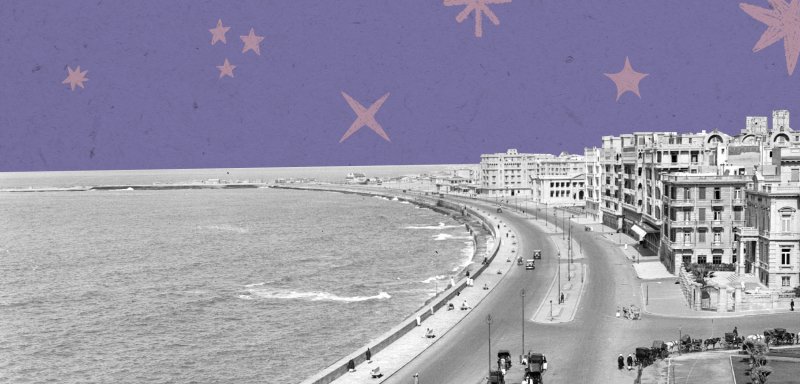
It took less than a week after my arrival for me to find myself outside the walls of Cinema Othman again. On the way there, I drove past the revamped corniche, once a narrow strip that curved along the coastline dotted with fishermen, food carts, and chipped benches, now rebuilt in the image of a metropolitan Gulf city that itself had been rebuilt in the image of somewhere else. A copy of a copy of a copy.
The nostalgia I had for the sea had been gutted and torn apart. I drove past an infinite number of cafés named Ocean Station and Sea Breeze Lounge, all of them lined up like a battalion of riot shields stacked shoulder to shoulder, choking out any glimpse of what they’re named after.
I drove past the revamped corniche, once a narrow strip that curved along the coastline dotted with fishermen, food carts, and chipped benches, now rebuilt in the image of a metropolitan Gulf city that itself had been rebuilt in the image of somewhere else. A copy of a copy of a copy.
The air by the cinema’s entrance greeted me differently this time. It was clear, almost polished, as though it had been rinsed of anything that had ever clung to someone’s clothes on the way home. The old popcorn machine that had announced itself before the door gave way. Its sweetness—scorched at the bottom of the box, the butter settling deep into the throat—was gone.
The luminescent stars that trailed across a purple carpet were replaced by a shade of beige precisely chosen because no one could object to it; a color arrived at by abstraction. It was, undoubtedly, cleaner, but thinner, as though the cinema’s floors had been brought closer to the soles of my feet. It did not invite the eye, but it also did not resist it. It received it and offered nothing back in return.
Everything else around it had been rearranged. A hallway by the entrance that led to a malfunctioning escalator, where, as kids, my brother and I raced against its direction minutes before the movie started, had been relocated to the other side of the theater. It worked just fine.
A member of staff eventually spotted me wandering like a stray dog and asked if I had tickets to see a film. I didn’t, but I explained that I had been living abroad for a decade, conjuring a photo that once hung on the wall directly behind him fifteen years ago. He blinked twice. The photo didn’t exist to him.
I’d like to think that, on some level, I had already known and accepted that things wouldn’t be the same. After all, time devours us all. The machine must grind on as capitalism swallows its own tail. Whatever. But some things have been deemed too sacred to disappear. The Great Pyramids. The Temple of Hatshepsut. They’re still here. So, why wouldn’t Batman and Abaza still be there, permanently entangled in that inexplicable threesome with El Atrash? Where else could they go?
French anthropologist Marc Augé would coin the term “non-places” a decade later to refer to spaces that we weren’t meant to remember, like airports and chain hotels. Most major cities were filling up with these “voids,” according to him, all while the places that once gave people a sense of who and where they were were quickly disappearing beneath them.
My questions led me back to the car as I drove toward Green Plaza to find Karamantas, a pastel castle with crenelated walls, bouncy houses, trampolines, and arcades. My friends and I spent entire afternoons between its walls when we were young. Surely, I thought, it must still be there.
And technically, I was correct.
Except it wasn’t called Karamantas anymore. Frenzy Station had replaced Karamantas; its words hung above the entrance in a rounded, cheerful font, with letters that would wink at you if they could. The colors around the castle were a more palatable shade of yellow. The trampolines were still there, and people were still using them, but what was once Karamantas had been transformed into a place that catered to everyone: children, families, teenagers, and athletes in compression shirts performing box jumps to tone and optimize their bodies.
I suppose this is simply what progress looks like from the inside. Maintaining a successful business today means succumbing to the carefully curated aesthetics of conformity. Why be specific when you could be another template borrowed from any city, mall, or country? Those storefronts could look like something else tomorrow. Maximalism. Retro-futurism. Heritage chic. Whatever the consultants decide sounds enticing at the next strategy meeting. But today, it looks like Frenzy Station, which also happens to look like everything else. Every storefront, every development, is similarly rearranged so you don’t notice the repetition.
Maintaining a successful business today means succumbing to the carefully curated aesthetics of conformity. Why be specific when you could be another template borrowed from any city, mall, or country?
To claim that cities are rebuilt to serve those who inhabit them is to misunderstand how they grow. They are reimagined for the flow of money and labor to slip through without resistance. Marxist geographer David Harvey referred to this process as capitalism “annihilating space to ensure its own reproduction.” This insatiable need for surplus capital, shoved into every corner of our physical environments, is precisely what traps us in a Sisyphean task of endless reconstruction. Tear the memories down, rebuild them, polish them, tear them down again, shove some more cash in, only to tear them down again just in time for the next investment cycle.
What Augé didn’t fully reckon with is that voids are not merely new, non-places; the voids creep back into what once was, holding the memories in place whilst sanding them down to total distortion. They have eaten away our malls, cinemas, restaurants, and the public squares that predate the anthropological invention of a public square. Nothing is immune—not specificity, not the weight of centuries. It’s an unstoppable current that we cannot single out and blame.
Karamantas and Cinema Othman were no cathedrals — they were, after all, businesses. Places designed to grab attention, extract profit, and keep people coming back. Nobody builds a pastel castle with crenelated walls to serve the public. But these places, for all their manufactured spectacle, illuminated the gaps within them. Because we are sentimental creatures, we find our way into those gaps to leave parts of ourselves behind.
The image from my childhood must be in a landfill by now, the ashes of my childhood mixed with thousands of other baffling remnants that had composed somebody else’s life. Traces of Abaza’s face, decomposing next to Batman’s body, with El Atrash in a pool of our discarded sludge.
Now and then, I like to imagine the moment the image was taken down—how unremarkable it must have been. A decorator with a clipboard walking through, noting the superfluities and inefficiencies.
What is this? Why is it here? A staff member probably shrugged: it’s always been there. We can take it down.
Raseef22 is a not for profit entity. Our focus is on quality journalism. Every contribution to the NasRaseef membership goes directly towards journalism production. We stand independent, not accepting corporate sponsorships, sponsored content or political funding.
Support our mission to keep Raseef22 available to all readers by clicking here!
Interested in writing with us? Check our pitch process here!