 إقرأ باللغة العربية:
In their home countries, it seemed the clock was always speeding ahead of them. Time stood guard against them, assigning fixed years and specific deadlines for achieving certain things, and hampering their progress with questions like: Can I start over?
In many Arab societies, women believe that life is an exhausting race and that their dreams come with an “expiration date.”
But in the diaspora, time moves differently. No one chases them with questions about age, and their worth is not measured by a sequence or hierarchy of accomplishments. Abroad, a woman can begin anew: study, change her career path, wear what she wants, speak without fear, and take her time molding herself in her vision.
As such, Arab women in the diaspora bloom in the autumn of their lives. Perhaps because true spring arrives when time finally becomes theirs to own.
Some migrant women, even later in life, succeed in reshaping their roles away from the traditional roles and frameworks of their countries of origin.
The woman in the green coat
Last autumn, my cousin Durra, a 62-year-old mathematics professor who has lived in the United States since 1997, called me. She told me she would be passing through Paris on her way back from Tunisia and invited me for a cup of coffee. We agreed to meet at a small café near the Montparnasse Tower.
When I arrived, the Montparnasse Tower stood bright, defying the gray sky and the smoke rising from the city’s chimneys. On the sidewalk in front of the café, Durra stood tall like a tower of light herself, wearing a long green coat that stood out against the grey masses of Parisians.
We talked about her life, her two sons, her work, and she reminisced with me over Paris, where she lived for five years. As I watched her speak, I gradually realized how different her story was from the stereotypical image often drawn of Arab migrant women in France and other host countries, especially as they grow older.
In mainstream or dominant narratives, migrant women are often portrayed as victims of vulnerability, poverty, or perpetual alienation and exile. Public discourse frequently frames them as a group suffering from structural crises. But Durra, with her confident conversation, elegant presence, and vibrant words, presented a completely different image; the image of a woman embodying strength, independence, and the ability to redefine herself beyond ready-made, overused molds.
Researchers working on social issues examine societal perceptions of aging, where migrant women who have moved beyond youth are often viewed as dependent on others or unable to enjoy their full rights. Such perceptions frequently lead to the marginalization of the voices of older groups, especially when age intersects with gender and cultural background, as is the case for migrant women.
In a study published in March 2012 by the Institute for Research and Information in Health Economics (IRDES), one of the first studies examining the integration of elderly migrants in Europe with a particular focus on gender differences, it was revealed that older migrant women faced twice the burden of gender-based and cultural discrimination, limiting their access to support networks, employment opportunities, and healthcare services. These women also participated less in community life and volunteer activities compared to female citizens or migrant men, which negatively impacts their trajectory of social integration.
The study highlights a key point. It notes that some migrant women, especially at later stages in their lives, succeed in making use of the spaces offered by host societies to reshape their roles beyond the traditional molds imposed on them by their home communities. This enables them to thaw ambitions that had long been frozen. This applies perfectly to Durra, who represents a different model that defies the ready-made depictions usually drawn of older migrant women. Her experience was not an exception; rather, it reflects a courageous path taken by many women who refuse to be reduced to statistics of weakness or dependency.
Durra, with her confident conversation, elegant presence, and vibrant words, presented a completely different image; the image of a woman embodying strength, independence, and the ability to redefine herself beyond ready-made, overused molds.
The secret of the orchid
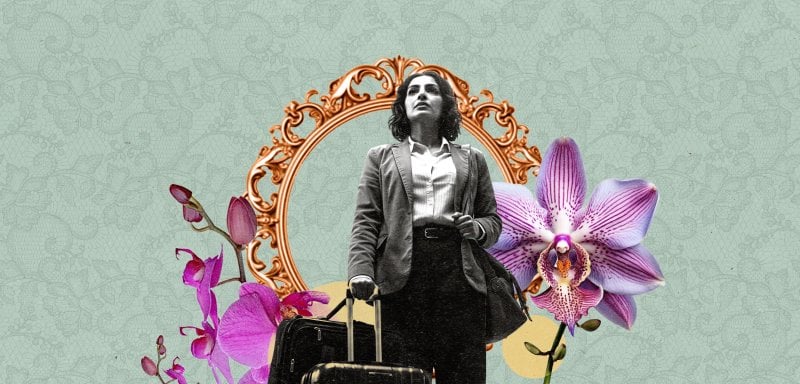
Perhaps the enchanting orchid flower, symbolizing strength and femininity, best captures the spirit of the Arab migrant women whom Raseef22 spoke to for this story.
The most remarkable thing about this flower, aside from its striking elegance and multitude of colors, is that most orchids do not grow in soil. Instead, they cling to the trunks of trees or rocks, just as Arab women who have blossomed in the diaspora, far from a land whose language they speak and whose soil they love, yet whose earth once grew too tight for their dreams.
Thurayya, 68, is of Moroccan origin but lives in Paris.
“I came to France more than 40 years ago to study, and I worked in several fields while studying at the Sorbonne, where I specialized in French literature,” she shared. “Today, I look at my journey with immense gratitude. I was part of this country’s economic cycle, and as a retiree now, I enjoy all my rights.”
Meanwhile, Dr. Jawaher Bawab, 62, a Tunisian physician specializing in radiological diagnosis and medical imaging, described her experience in the diaspora as rich and full of challenges. The Tunisian doctor, who spent 11 years moving between Tunisia and France to take her expertise back to her homeland, likes to describe herself as a mother of three and a grandmother.
“I never felt that aging limited my ambition or my ability to grow,” Bawab told Raseef22.
The same is true for Sana, 57, a Tunisian migrant who lived in France and currently resides in Canada. She believes there is no expiration date for self-development.
“I arrived in Canada 25 years ago, and throughout this journey, I never stopped growing and taking on challenges. I changed my profession twice, I studied and continue to learn, and I believe that a person can grow at any stage of life,” she said. “Today, I see myself as a model of active citizenship; I work hard, contribute to the economy, pay taxes, and support other women who are going through similar experiences.”
Between two worlds
For the women interviewed throughout this story, migration was not merely a geographical move. It was an ongoing journey of proving oneself, adapting to the host country without severing one’s roots, and balancing between two identities to which they feel a sense of belonging without fanaticism.
Layla, 65, a Tunisian migrant living in Paris, embodies this challenge when she said: “I came to France more than 40 years ago, and today I am a mother of four daughters, a grandmother of five grandchildren, and have been retired for a year. I feel great pride in my daughters and grandchildren, and in everything I have accomplished over all these years. I managed to integrate into a different society, worked hard, and built a balanced family that preserved its Tunisian roots while also adapting to the French way of life.”
For her part, Amal, 64, also a Tunisian migrant living in Paris, told Raseef22 that education and preserving her heritage were among the most important priorities she held onto throughout her integration journey in the host country.
“I always made sure my children were among the best in their studies, and I taught them that they are French despite their differences, and that they should integrate into society without abandoning their Tunisian identity,” she recalled. “In addition, I have long been active, and continue to be active, in several associations concerned with reading, the arts, and women’s rights.”
Durra does not hide, in her conversation with Raseef22, that raising her two sons was one of the greatest challenges she faced during her American exile.
“I knew from the beginning that raising them would not be easy, especially in an environment that tends to melt identities into a single mold,” she admitted. “I made sure they spoke Arabic at home and that they learned about their roots, not only through the stories I told them, but also through regular visits to Tunisia, where they came to understand that they had a wider sense of belonging than the place they were growing up in.”
Durra explained that having her brother and her two cousins in the United States gave her the feeling that she had a small family in the diaspora.
“We tried to preserve our customs, especially during Ramadan and the holidays, to feel that we had not lost our connection,” she said. “Even at home, I make sure to cook Tunisian couscous every Sunday, as though it were a ritual that tied me to my roots and resisted the rapidly changing culture around me. I used to tell myself that I wasn’t just dealing with different food, but was rather preserving for my sons a memory and an identity that extended beyond the place where they had grown up.”
As for Jawaher, she chose to live between two countries, which offered her “comfort and balance.”
“Thanks to this lifestyle, which I call the ‘Ibn Battuta lifestyle,’ I’ve been able to stay close to my son, who lives in Tunisia, while also remaining close to my other two sons who live here in France, especially my grandson, whose life I am keen to be part of.”
The role of the grandmother has also become an essential part of the lives of many migrant women, as they play an important role in supporting younger generations and helping them balance between the two cultures.
“My grandchildren are my greatest joy. I always try to pass on to them our values and traditions, and I tell them stories about our homeland so they don’t forget their roots,” Layla said. “At the same time, I encourage them to integrate into the society they live in, because their future is here.”
A compulsory path
One of the deepest challenges migrant women face in host societies is being forced to start over academically or professionally. They often encounter the reality of their academic degrees or professional experience not being recognized, which pushes them to pursue further studies and acquire new skills in different fields, in an attempt to prove themselves and keep moving forward.
Because host countries do not recognize their degrees and experience, migrant women are forced to start from scratch — a difficult experience, but one that can also be a motivating challenge.
“When I arrived in Canada, my degree wasn’t recognized, so I found myself forced to go back to school so that I could work,” Sanaa said. “I began in the field of caring for children with autism spectrum disorder and behavioral difficulties, but later, I wanted to try a different profession. I went back to studying again, and today I’m living an entirely new career path.”
Thurayya, meanwhile, chose to view this challenge as an opportunity for growth. “When I came to France, I had been dreaming of teaching, but I quickly realized that I had to adjust my path. I studied French literature at Sorbonne University, and I had to work in other fields while studying,” she said. “It wasn’t easy, but I believe that rebuilding is not just a change, but a real opportunity for growth and learning.”
Emotional commitments
With remarkable insight, Arab migrant women recognized that organizing themselves and exchanging support and expertise among one another is one of the essential pillars that helps them persevere, grow, and integrate quickly into host societies.
For this reason, they became involved in community associations and initiatives aimed at supporting migrants and accelerating their integration through collective work and civic engagement.
“At the beginning, more than 40 years ago, I was looking for a space where I could express myself and connect with women who shared the same challenges,” Amal said. “Layla and I joined the Democratic Organization of Tunisians in France (ADTF), where we took part in activities aimed at helping migrant women integrate. Later, I joined the City of Women’s Rights (Cité des Droits des Femmes), where I began participating in empowerment workshops to help women rebuild their professional and personal paths. Today, I feel stronger and more capable of supporting others on their journey.”
But resistance was not limited to organizational frameworks; it also manifested in everyday acts of solidarity among migrants, reflecting a shared sense of responsibility.
“When I see a migrant in need of help, I cannot remain neutral. I offer support even if it falls outside the scope of my official work, whether through translation, guiding them to health services, or even helping them schedule a medical appointment,” Dr. Jawaher explained to Raseef22 “I feel it is my duty, because I know exactly how difficult it is to navigate a complex healthcare system when your French is weak or when you don’t know your rights as a migrant.”
This deep sense of responsibility shows how migrant women do not simply adapt to their new reality, but become active agents within their surroundings, offering support to others from a place of lived experience. In this way, their commitment to the marginalized becomes a conscious act of resistance in the face of discrimination and exclusion, and not merely an expression of sympathy.
Intelligent longing and nostalgia
Amal, Layla, and Thurayya recalled their earliest memories in exile, speaking passionately about the moments that gathered them around the first broadcasts of Radio Orient.
“Radio Orient was, for us, a dream taking shape in voices coming to us from afar, connecting us to the outside world,” said Layla, smiling as though reliving those days. “We never imagined that technology would reach the point it has today, but back then, that radio was our small window to the news of the Arab community here.”
Amal continued: “At first, we were a small group of Arab friends, and integrating into the new society was not easy. But over time, and thanks to our strong bond, we managed to overcome the difficulties and adapt to our life here.”
Modern technology has contributed greatly to helping migrant women maintain cross-border connections through constant communication with their families abroad or by allowing them to return to their home countries whenever possible.
“When my mother fell ill, I monitored her health condition from afar, making sure to check on her constantly,” Jawaher said. “I cannot deny that my constant movement between Tunisia and France played a major role in my experience, as it made me feel like I was present in both places at the same time.”
In my image
For Arab women abroad, determination, resilience, and an extraordinary ability not only to adapt but to flourish in places that were not always ready to welcome or celebrate them.
As I was saying goodbye at the café door, Durra pulled her green coat tightly around her body, defying the cold just as she had, for years, defied the stereotypes that tried to confine her to roles that were never hers.
I looked at her and saw in her more than just a relative; I saw a symbol of women’s resilience, a strength that tells the story of women who have never stopped rebuilding themselves despite distances and despite the differences that exile carries.
When she left, I kept thinking about everything she and the women I met with while preparing this piece had shared with me. I thought about her deep laughter that hides behind it stories of struggle and challenge, and her gaze that carries the breadth of two identities that do not clash but now complement each other.
Thus, just as the orchid does not wither despite the changing seasons, women like Durra remain rooted despite the winds, blooming when it’s the right time.
Raseef22 is a not for profit entity. Our focus is on quality journalism. Every contribution to the NasRaseef membership goes directly towards journalism production. We stand independent, not accepting corporate sponsorships, sponsored content or political funding.
Support our mission to keep Raseef22 available to all readers by clicking here!
Interested in writing with us? Check our pitch process here!